Developed for: Techno Smart Diamond Solutions
The Traditional Process
Diamond polishing is one of the oldest precision crafts in the world. A skilled craftsman - called a polisher or "bruter" - studies the raw diamond under a microscope, identifies the crystal structure, and manually plans how to cut and polish each facet to maximize the final gem's weight and optical quality. The diamond is mounted on a small dop stick using wax or adhesive, then pressed against a rotating scaife - a cast iron disc embedded with diamond powder and oil at precise angles for each facet.
A single diamond can have 57 or more facets. Each one requires a deliberate decision about angle, pressure, and duration. A miscalculation removes too much material and permanently reduces the stone's value. The entire process depends on the craftsman's experience, eyesight, and muscle memory and is extraordinarily difficult to scale or replicate consistently.
This project was built to automate that process.
What This System Does
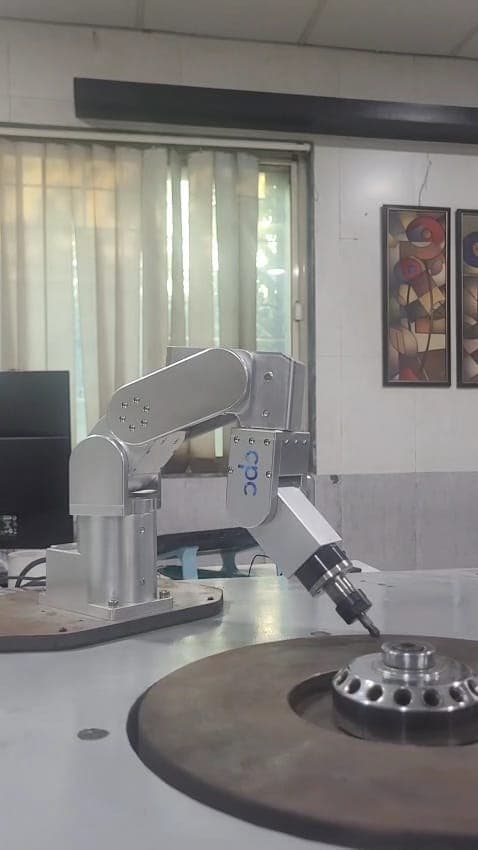
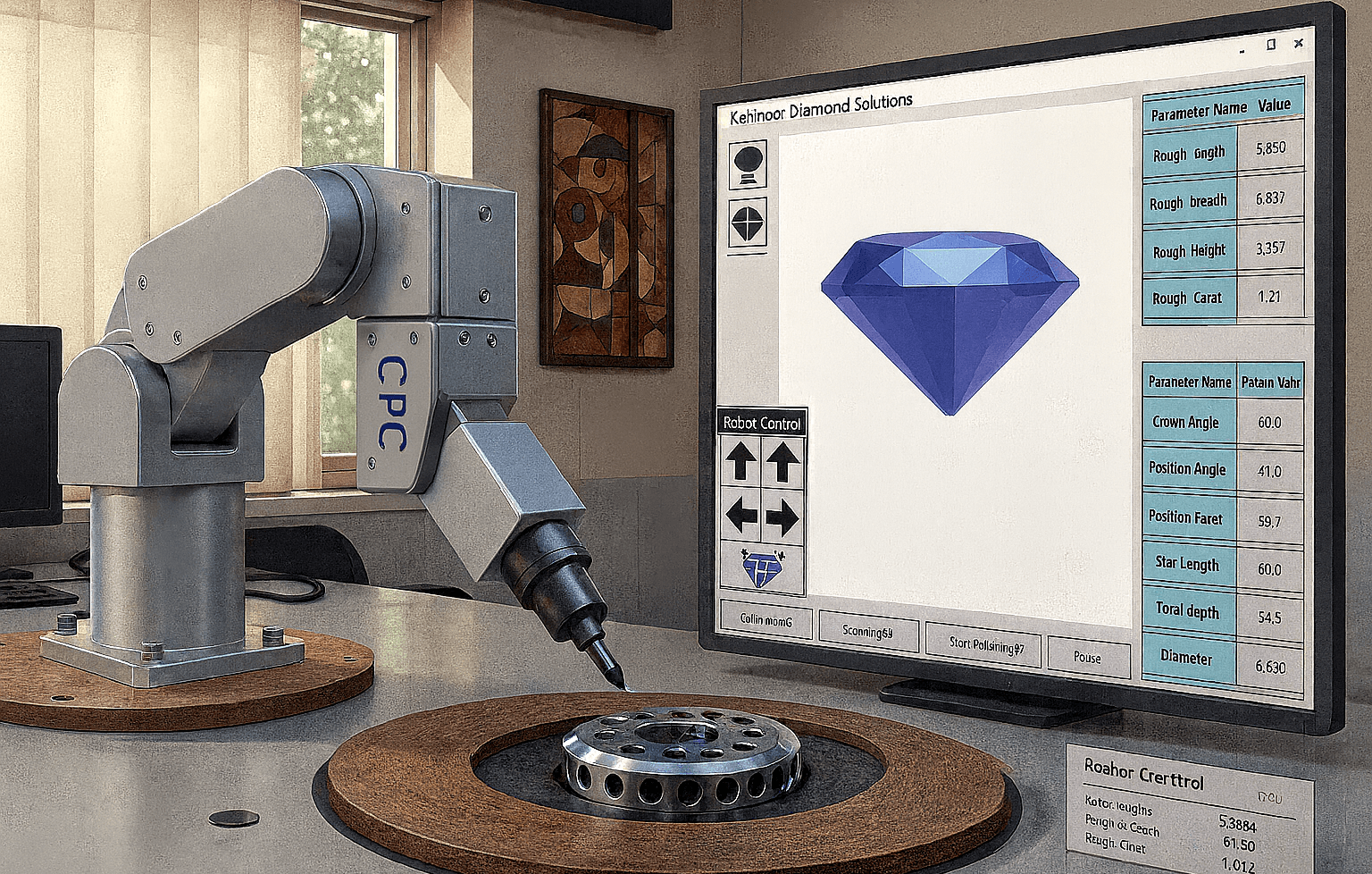
The automation system replaces the manual inspection, planning, and polishing steps with a closed-loop robotic pipeline. A preprocessed diamond, already attached to a tool mount is loaded into the system. The robot arm carries it through scanning, planning, and polishing in sequence, returning to scan between polishing passes as needed.
The system covers three stages:
3D Reconstruction from Microscopic Imaging A microscopic camera captures 2D images of the diamond surface. A custom computer vision algorithm converts these into a 3D mesh of the diamond geometry. Mesh reconstruction accuracy was achieved at 5 microns. Scanning time ranges from 10 to 30 seconds depending on diamond size.
Polishing Path Planning A custom planning algorithm analyzes the 3D mesh and computes an optimal polishing sequence that maximizes the volume of the final polished diamond, preserving as much material as possible while achieving the target facet geometry. This is the core engineering problem: every microgram of removed material is value lost.
Robotic Execution The robot arm executes the planned polishing path. Rather than a standard robotics middleware, the system was built on a C++ API provided directly by the hardware manufacturer, which was wrapped in Python to integrate with the vision and planning pipeline. Polishing accuracy was achieved at 10 microns. After each polishing pass the diamond is returned to the scanner and the mesh is updated, allowing the system to adapt the remaining plan based on actual material removal.
Technical Details
The full pipeline runs without any standard robotics middleware such as ROS. Robot control was handled through a manufacturer-provided C++ API, wrapped in Python to interface with the vision and planning modules. The 3D reconstruction, planning algorithm, and motion execution were all developed and integrated during this engagement.
This was a production deployment, not a prototype. The system was delivered to and used by Techno Smart Diamond Solutions in active manufacturing.
Due to an NDA, specific implementation details and hardware specifications cannot be shared publicly.
Results
Mesh reconstruction accuracy: 5 microns Polishing accuracy: 10 microns Diamond scan time: 10 to 30 seconds depending on stone size Deployment status: Production system delivered to Techno Smart Diamond Solutions